

Contextual Chunk Retrieval Without Special Embeddings
Contextual chunk retrieval stores every small piece of text as one vector: 80% the piece's own embedding and 20% the embedding of the passage around it. Queries are built the same way. The incoming message is split into parts, each part is blended with the whole message, and each part runs its own search and keeps its own results.
text-embedding-3-small. No token-level access, no special model, and no generated context text.This post covers both sides, the code we run, and what it measured.
The problem it solves
Our assistant missed my dogs' names in a voice turn. The names were stored, and a direct search for them worked. The same turn also carried a long engineering correction, so the one vector for the whole message pointed at engineering, and the dog facts lost the ranking.
That failure has two parts, and each needs its own fix.
The blend
E(text) be an embedding from one model at one dimension, and unit(v) scale a vector to length one. For a piece s inside a passage C:textstored = unit(0.8 * unit(E(s)) + 0.2 * unit(E(C)))
q inside a message P:textquery = unit(0.8 * unit(E(q)) + 0.2 * unit(E(P)))
Normalize both inputs before mixing. Otherwise their lengths change the effective weight. Here is the function both sides call:
tsexport const CHUNK_FOCUS_WEIGHT = 0.8

function unit(vector: number[]): number[] {
  const norm = Math.sqrt(vector.reduce((sum, value) => sum + value * value, 0))
  return norm > 0 ? vector.map((value) => value / norm) : vector
}

export function chunkSearchVector(chunk: number[], message: number[]): number[] {
  const a = unit(chunk)
  const b = unit(message)
  return unit(a.map((value, i) => CHUNK_FOCUS_WEIGHT * value + (1 - CHUNK_FOCUS_WEIGHT) * (b[i] ?? 0)))
}
The result has the same dimension as the input, so any cosine index searches it unchanged.
When both sides are blended, the dot product of a query and a stored vector expands into four terms. Before the final normalization:
text0.64 * dot(query_piece,   stored_piece)
+ 0.16 * dot(query_piece,   stored_context)
+ 0.16 * dot(query_context, stored_piece)
+ 0.04 * dot(query_context, stored_context)
Piece-to-piece matching carries most of the score. The two cross terms let each side's context lean on the other side's piece. The last term rewards two passages that agree. That's what lets the same sentence stored in two contexts rank differently for a detailed query.
The blend works on finished vectors. The piece's tokens never see the passage inside the model, so it isn't late chunking. It can only keep distinctions the embedding model already captures.
Query side: split the message
splitPromptChunks cuts the incoming message into at most 8 parts:- Split on line breaks and after
.,!or?. - Cut any piece longer than 60 words into windows of 40 words. Unpunctuated voice transcripts hit this often.
- Join any piece shorter than 24 characters to the piece before it. "Or anything about them?" isn't a search on its own.
- If more than 8 pieces remain, join neighbours into 8 runs, so every part of a long message still gets searched.
chunkSearchVector. The whole-message input is capped at 8,000 bytes, keeping the end, because the latest text is usually the question. Cap by bytes, not characters. A character cap lets CJK text run past the model's 8,192-token limit.Stored side: labelled pieces
Each sealed turn of agent history becomes a set of pieces.
tsexport function packTextPieces(text: string, maxBytes: number): string[] {
  const pieces: string[] = []
  let current = ''
  for (const line of text.split(/\n+/)) {
    const sentences = line
      .split(/(?<=[.!?])\s+/)
      .map((s) => s.replace(/\s+/g, ' ').trim())
      .filter(Boolean)
      .flatMap((s) => cutWithinBytes(s, maxBytes)) // over-budget sentence → cut at the last word that fits
    sentences.forEach((sentence, index) => {
      const joiner = !current ? '' : index === 0 ? '\n' : ' '
      if (current && bytes(current) + bytes(joiner) + bytes(sentence) > maxBytes) {
        pieces.push(current)
        current = sentence
      } else {
        current += joiner + sentence
      }
    })
  }
  if (current) pieces.push(current)
  return pieces
}
[Turn 4 · Tool logistics_export · Oct 16, 2:02 PM]. The header is part of the embedded text, so a tool result and a user request about the same thing still embed differently. Subtract the header's bytes from the budget before packing.tsconst context = meanVector(turnPieceVectors) // mean of unit vectors, then unit const stored = turnPieceVectors.map((v) => chunkSearchVector(v, context))
We chose the mean for two reasons. It needs no extra embedding call. It also never hits the input limit, because a long tool-heavy turn can exceed 8,192 tokens while its pieces never do. We measured the alternative, embedding the turn's text as the context. It scored 0.5 points higher, which wasn't worth an extra call per turn and a cap on large turns.
dimensions setting is a truncation of its full vector, so you can cut a 1,024-dimension vector to its first 256 numbers and renormalize to get the same result.What it replaced
The old indexer stored one vector per turn. It aimed for chunks of about 200 words but only split between turns, so any turn of 200 words or more became one chunk however large it was. Tool arguments were cut to 500 characters, and tool results over 4,000 characters were left out. A search for one detail in a big turn scored against the average of the whole turn. Turns over 8,192 tokens were refused by the embedding model and had no vector at all. That was 6% of the old chunks.
We rebuilt the existing archive once: 2,710 sections became 93,042 pieces, with no failed embeddings.
Search: every part gets its own group
i:textgroup_i = top_X(stored vectors with cosine(query_i, v) >= threshold)
- Build the part's blended query vector.
- Search in parallel with the other parts.
- Keep up to X matches above the threshold.
- Attach them under that part's group in the prompt.
Every part has the same allowance. A part with fewer qualifying matches returns fewer, and we don't pad a group with weak results. Keep the groups through prompt assembly. A final global top-X would put the parts back in competition. We don't deduplicate across groups. A memory that supports two parts appears in both.
Our graph-fact search has run this way since October 9: X = 5, cosine ≥ 0.35, at 1,024 dimensions. The 0.35 floor came from the dogs case. The dog-name fact scored 0.38.
The search over the labelled pieces still takes one whole-message vector and keeps one winner. Moving it onto the same split is the next change, and we'll measure it with real messages as queries before it ships. When it does, both sides of every comparison will have the same shape: a sentence-sized part carrying 20% of its message against a small piece carrying 20% of its turn.
Results
Controlled test
The first test made the sentence alone insufficient. We wrote 96 synthetic records across 24 sentence families. Each family used the same sentence in four different contexts. Eight families were for development and sixteen for evaluation: 128 context-specific queries and 16 generic ones.
The records came in two blocks, searched separately. The first block had 64 records using different senses of words like "key", "thread" and "session". The second had 32 records using the same subject for different purposes, for example rotating, scoping, storing or auditing an API key. Fixtures and target labels were fixed before embedding, and IDs and labels were never embedded.
text-embedding-3-small at 1,024 dimensions with exact cosine search. No word search, no reranker, no approximate index. Noisy conditions kept the relevant text and added five unrelated sentences.Correct-context top-1 accuracy on the 128 evaluation queries:
| Representation | Clean | Stored distractions | Query distractions | Both distracted |
|---|---|---|---|---|
| Isolated sentence on both sides | 25.0% | 25.0% | 25.0% | 25.0% |
| Whole passage and whole query | 100.0% | 94.5% | 57.8% | 36.7% |
| 80/20 blend on both sides | 100.0% | 96.1% | 71.9% | 50.8% |
The isolated-sentence row ties four ways in every family, so each tied candidate gets a quarter of a hit.
The blend helped once unrelated text competed with the intended context. With query distractions, 92 of 128 first results were correct, against 74 for whole passages. With both sides distracted it was 65 against 47. Both gaps are 14.1 points. On clean text the whole passage already scored 100%.
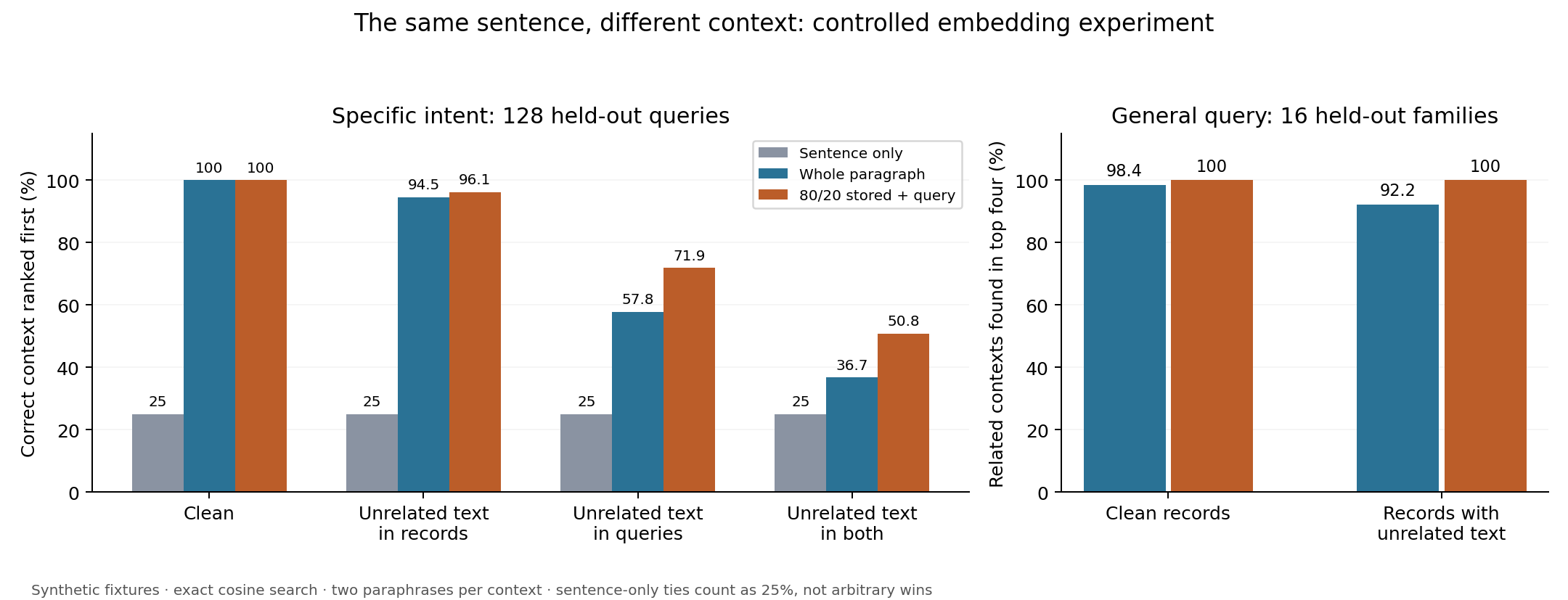
Generic queries contained only the shared sentence. With blended stored vectors, all four contexts took the top four positions in every evaluation family: 64 of 64.
The stored side matters. Blending only the query, against whole-passage stored vectors, scored 36.7% with query distractions, below the 57.8% baseline.
Production threads
After the stored side shipped, we compared it against the old whole-turn chunks on real data:
- Threads: 51 production threads, all of them with sealed history.
- Old chunks: rebuilt in memory from the same messages with the pre-change code, then embedded.
- New pieces: read from production. A recompute matched the stored vectors exactly (cosine 1.0000).
- Queries: 1,868 facts already stored for those sections. These are real sentences about what happened in those turns.
- Right answer: a hit inside the section the fact came from.
- Scoring: vector search only, scoped to the thread, using the same score as production recall.
| Measure | Whole-turn chunks | Labelled pieces |
|---|---|---|
| Top hit in the right section, above the recall floor | 36.8% | 58.9% |
| Top hit in the right section | 43.9% | 60.6% |
| Mean reciprocal rank | 0.579 | 0.697 |
Most of the gain comes from piece size. Small labelled pieces against one averaged vector per turn did the heavy lifting. The 80/20 blend added 1.1 points on top, and embedding the turn's text as context instead of the mean would have added 0.5 more.
One probe shows the mechanism. We buried a detail in a 400-row tool result. The piece holding it ranked first of 39 at cosine 0.59. The old whole-turn vector for the same turn scored 0.45.
(1 + cosine) / 2, so the 0.75 recall floor is a raw cosine of 0.5. The probe's piece passes. The old whole-turn vector didn't.This eval measured vector search only. Production also runs word search alongside it, which this table doesn't include.
Where this sits next to other methods
| Approach | How context gets in | What you need | Result allocation |
|---|---|---|---|
| Isolated chunk embedding | Only the chunk's text | Any embedding endpoint | Up to the retrieval system |
| Late chunking | Tokens encoded with the larger text, then pooled per chunk | Token vectors and pooling control, or an API that does it | Up to the retrieval system |
| Contextual Retrieval | Generated explanation prepended to each chunk | A generation call per chunk, then embedding and BM25 | Up to the retrieval system |
| Weighted blend | Piece vector mixed with a context vector after embedding | Final vectors from one model and dimension | Up to the retrieval system |
| This post | Blended pieces and blended query parts | Batched embeddings and parallel searches | Up to X per query part |
all-MiniLM-L6-v2.None of these share a dataset with our tests, so the table compares architecture, not accuracy.
Limits
Build checklist
- Split stored text by source: user message, each assistant step, each tool call with its full result.
- Pack sentences into pieces of at most 1,200 bytes, cutting any longer sentence at the last word that fits.
- Prefix each piece with a label for its turn, source and time, and count the label against the budget.
- Embed the pieces in batches sized by input count and bytes before sending.
- Store each piece as
chunkSearchVector(piece, meanVector(turn's pieces)). - At query time, split the message into at most 8 parts with
splitPromptChunks, and embed the parts and the whole message in one request. - Blend each part with the whole message using the same
chunkSearchVector. - Search each part in parallel, keep up to X results above the threshold, and keep each part's group intact into the prompt.
- Measure on your own threads with stored facts as queries before you pick the piece size, X or the threshold.